
IgG vs IgE Testing: Which Test Do You Actually Need?

Search for a food intolerance test and you will quickly find two very different stories: someone saying it changed their life, and someone else saying it was a waste of money.
If you are already bloated, uncomfortable and unsure what to eat, that is hardly helpful.
IgG and IgE sound similar, but they measure different antibodies and have different uses. Choosing between them starts with one question: what are you trying to find out?
At FIT Nutrition & Testing Clinic, I offer food testing with personalised nutritional support. Here is my guide to what each test can tell you, where the IgG debate stands and how to choose your next step.
Contents
IgG vs IgE testing in 30 seconds
IgE testing for suspected food allergy
What does an IgG food intolerance test measure?
Why is IgG testing controversial?
What if someone feels better after an IgG-guided diet?
Which test do you actually need?
Food testing and personalised support at FIT
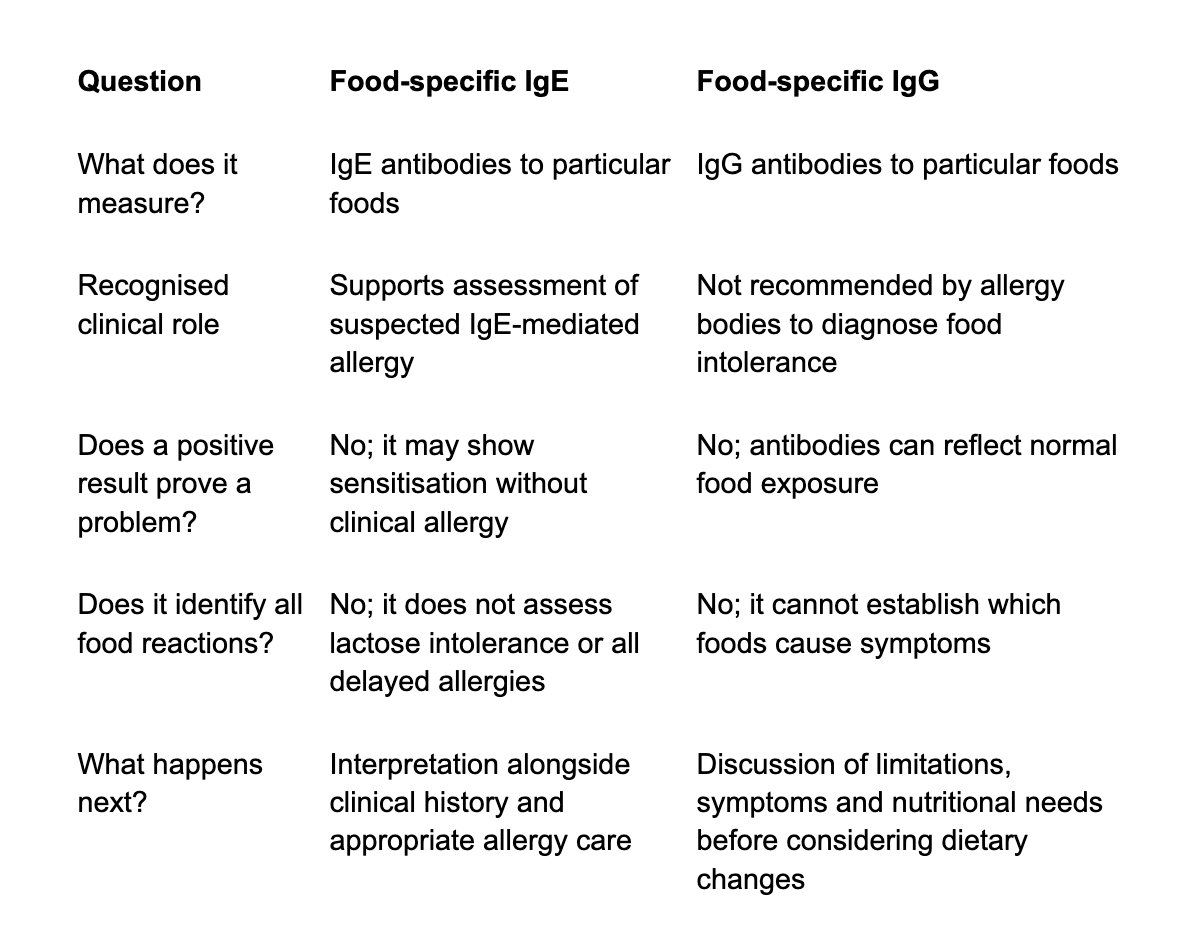
IgG vs IgE testing in 30 seconds
Food-specific IgE testing can help investigate suspected immediate food allergy when interpreted alongside your reaction history.
Food-specific IgG testing measures a different antibody response, which can occur normally after eating foods. An elevated IgG result does not establish food allergy or intolerance.
IgE testing for suspected food allergy
If eating a particular food repeatedly causes rapid itching, hives, swelling, vomiting or wheezing, an allergy assessment may be appropriate. Food-specific IgE blood tests can help investigate that pattern (BSACI).
The important word is specific. A clinician should consider which foods to investigate based on what actually happens when you eat them. Testing a long list without a relevant history can produce confusing results.
A positive IgE result may indicate sensitisation: your immune system recognises the food, but eating it does not necessarily cause an allergic reaction. The result also cannot reliably tell you how severe a future reaction will be. Assessment may include skin-prick testing or a medically supervised food challenge.
Some food allergies do not involve IgE. A negative IgE panel therefore cannot rule out every allergy, and it should never be used as permission to try a food after a concerning reaction.
Sudden throat or tongue swelling, breathing difficulty or collapse needs emergency help. Use prescribed emergency adrenaline immediately and call 999 (NHS).
What does an IgG food intolerance test measure?
Tests marketed as 'food intolerance' or 'food sensitivity' panels commonly measure food-specific IgG antibodies in blood. These antibodies can be present in healthy people who eat those foods without symptoms. Their presence can reflect exposure and, in some circumstances, tolerance.
That is why a result marked 'high' or 'positive' does not automatically mean a food is harming you. It does not measure the severity of an intolerance, prove inflammation or establish a need to stop eating the food.
IgG testing also does not assess lactose digestion, diagnose coeliac disease or replace an allergy assessment. The familiar shortcut 'IgE means immediate allergy; IgG means delayed intolerance' is not an accurate explanation of the science.
Why is IgG testing controversial?
The debate is not about whether a laboratory can measure IgG antibodies. It is about what those antibodies mean and whether using them to select foods improves care.
Professional allergy organisations, including BSACI, do not recommend food-specific IgG testing to diagnose food intolerance. The concern is that a normal antibody response can be mistaken for evidence of a problem, leading to unnecessary restrictions.
There is research worth discussing, however. In a 2004 trial of 150 people with IBS, the IgG-guided diet produced a 10% greater reduction in symptom scores than a sham diet overall. The often-quoted 26% difference came from the fully compliant subgroup.
More recently, a 2025 sham-controlled trial reported benefit from a diet guided by a particular IBS-specific, 18-food IgG assay. These findings deserve attention, alongside their limitations.
That is a reason to continue researching the approach. It does not validate every commercial IgG panel, establish that raised IgG causes symptoms or show that testing works for unrelated concerns such as eczema or fatigue. Evidence about one assay and one patient group should not be transferred automatically to another test or condition.
UK advertising guidance also requires robust evidence for claims that IgG testing identifies intolerances or that the resulting diet relieves symptoms (ASA/CAP).
My position is straightforward: the research is worth following, but emerging evidence and an established diagnostic test are different things. You deserve to understand that before buying.
What if someone feels better after an IgG-guided diet?
Their improvement matters. It does not, on its own, tell us which part of the process helped.
Removing several foods can also change lactose or FODMAP intake, meal patterns and overall diet. Practitioner support may bring other changes too. Feeling better after the programme does not prove that every flagged food was a trigger or that IgG antibodies explained the symptoms.
This is why symptom tracking and appropriate reintroduction matter. They help assess whether a dietary change is useful in everyday life and reduce the chance of avoiding foods indefinitely. Where allergy is suspected, reintroduction needs advice from the allergy team.
Which test do you actually need?
'My lips itch or I get hives soon after eating.' An allergy assessment comes first. Your GP or allergy team can decide whether targeted IgE testing is appropriate.
'I'm bloated and I cannot work out what sets it off.' Begin with your symptom history and what has already been investigated. A food diary, appropriate medical tests and a supported dietary trial may help clarify the pattern. An IgG panel cannot establish the cause of bloating.
'I think gluten is the problem.' Discuss coeliac testing before going gluten-free, because removing gluten can affect the investigation (NHS). See our Gluten Intolerance vs Coeliac Disease guide.
'Dairy and I don't get on.' Milk allergy and lactose intolerance need different assessments. Neither an IgE nor an IgG panel measures how well you digest lactose; a breath test may be appropriate.
'I already have an IgG report with lots of flagged foods.' You do not have to turn your fridge upside down. Seek help reviewing the results alongside your symptoms and nutritional needs before making exclusions.

References:
BSACI. Investigations for food allergy.
NHS. Food allergy.
Atkinson, W., Sheldon, T.A., Shaath, N. and Whorwell, P.J. (2004). Food elimination based on IgG antibodies in irritable bowel syndrome: a randomised controlled trial. Gut, 53(10), 1459-1464.
Singh, P. et al. (2025). A novel, IBS-specific IgG ELISA-based elimination diet in irritable bowel syndrome: a randomized, sham-controlled trial. Gastroenterology, 168(6), 1128-1136.
ASA/CAP. Food allergy and intolerance testing.
BSACI. Diagnostic diets.
NHS. Food intolerance.
This article provides general information and does not replace individual medical advice. Suspected food allergy requires appropriate medical assessment.
Don’t forget to pin it.
Food testing and personalised support at FIT
FIT offers food-specific IgG testing and combined IgE and IgG options with practitioner support. A combined panel measures both antibody types; it is not a complete screen for every food-related condition, and combining them does not remove the limitations of either.
Before you choose, we can discuss your symptoms, what a test can realistically tell you and whether another investigation would be more appropriate. If you already have results, I can help explain them in context, plan suitable food swaps and review any dietary changes.
The support matters beyond the results page: a plan that fits your life, protects nutritional variety and includes appropriate reintroduction rather than indefinite restriction.
You do not need to arrive knowing which test to buy. Start with your symptoms and let us work through the options together.
Take the free Find Your FIT Quiz to discover which test or programme suits your symptoms, or book a free 15-minute Personalised FIT Health Review with Becki for a direct, no-obligation conversation about where to start.

About Becki Hawkins
Becki Hawkins, BSc (Hons), mBANT, CNHC, is the founder of FIT Nutrition & Testing Clinic and a Registered Nutritional Therapist with over 20 years of experience. She specialises in evidence-based personalised nutrition and functional testing, helping clients uncover the root causes of digestive issues, hormonal imbalances, and unexplained symptoms. Becki combines clinical expertise with culinary creativity, translating complex test results into practical, delicious nutrition plans that work in real life. Her approach is simple: test, don't guess. Because guessing doesn't heal. Knowing does.