
Gluten Intolerance vs Coeliac Disease: How to Tell the Difference

Why your symptoms are only one part of the puzzle, and what to do before you give up gluten
Bloating after bread. Exhausted after pasta. Brain fog after a sandwich.
It is easy to conclude: 'gluten doesn't agree with me.'
But is it gluten intolerance, coeliac disease, a wheat allergy, or something else in the meal entirely? The symptoms can overlap so closely that you cannot reliably tell from symptoms alone. And there is one mistake I see repeatedly: removing gluten before coeliac testing. It may bring short-term relief, but it can also make an accurate medical diagnosis much harder.
Contents
The most important thing to know first
What is gluten
Coeliac disease vs gluten intolerance: the quick answer
What is coeliac disease
What is non-coeliac gluten sensitivity
Could it be wheat, but not gluten
What about wheat allergy
How is coeliac disease tested
Can a food intolerance test diagnose coeliac disease
What to do if you think gluten is causing your symptoms
The hidden cost of going gluten-free 'just in case'
If you are diagnosed with coeliac disease
How FIT can support you
FAQs
The most important thing to know first
Do not start a gluten-free diet before speaking to your GP and completing appropriate coeliac testing.
Coeliac blood tests look for antibodies produced in response to gluten. If you have already reduced or removed gluten, antibody levels and intestinal changes may settle, increasing the chance of a misleading result. NICE advises eating gluten in more than one meal every day for at least six weeks before testing, and continuing it until diagnosis is confirmed by a specialist.
Already gluten-free and worried about reintroducing it? Do not launch into a DIY 'gluten challenge.' Ask your GP or gastroenterology team for individual advice, particularly if your previous reactions were severe.
What is gluten
Gluten is a group of proteins found naturally in wheat, barley and rye. It appears in obvious foods such as bread, pasta, pizza, pastries, cakes and many cereals, but can also be present in sauces, soups, sausages, stock products, ready meals and beer.
Oats are naturally gluten-free, but standard oats may be contaminated with wheat, barley or rye during growing and processing. People with diagnosed coeliac disease need oats labelled gluten-free, and a small minority may also react to the oat protein avenin.
Coeliac disease vs gluten intolerance: the quick answer
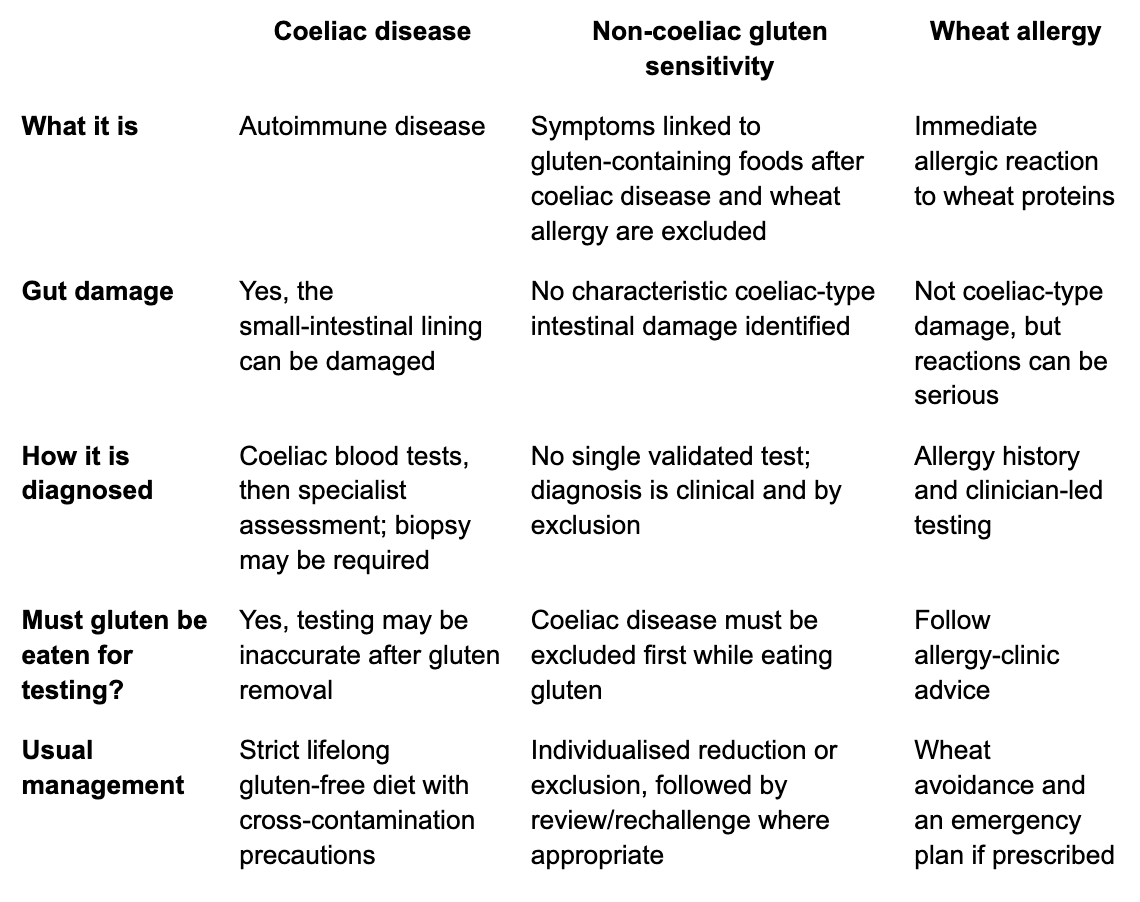
In everyday conversation, 'gluten intolerance' often means non-coeliac gluten sensitivity (NCGS). It is not the same as coeliac disease, and it is not the same as wheat allergy.
What is coeliac disease
Coeliac disease is an autoimmune condition. When someone with coeliac disease eats gluten, the immune system attacks the lining of the small intestine. The finger-like villi that help absorb nutrients can become damaged, increasing the risk of deficiencies and longer-term complications.
It is not an allergy. It is not a lifestyle preference. And it is not defined by how dramatic your digestive symptoms feel.
Coeliac disease symptoms: not always digestive. Some people have classic gut symptoms. Others have subtle, non-digestive symptoms, or very few obvious symptoms at all.
Persistent bloating, abdominal pain or excessive wind
Diarrhoea, constipation, pale or difficult-to-flush stools
Unexplained fatigue, weakness or brain fog
Iron-, folate- or vitamin B12-deficiency anaemia
Unintentional weight loss or poor growth in children
Recurrent mouth ulcers
An intensely itchy blistering rash called dermatitis herpetiformis
Headaches, tingling, balance problems or other unexplained neurological symptoms
Reduced bone density, osteomalacia or recurrent fractures
Fertility problems or recurrent miscarriage
NICE recommends offering coeliac blood testing in several higher-risk groups, including people with ongoing unexplained gut symptoms, prolonged fatigue, unexplained iron/B12/folate deficiency, autoimmune thyroid disease, type 1 diabetes, IBS in adults, and first-degree relatives of someone with coeliac disease.
That autoimmune thyroid connection matters. If you have Hashimoto's or another autoimmune thyroid condition alongside gut symptoms or unexplained deficiencies, coeliac disease deserves proper consideration, not an improvised gluten-free trial.
What is non-coeliac gluten sensitivity
Non-coeliac gluten sensitivity describes symptoms linked to gluten-containing foods after coeliac disease and wheat allergy have been excluded. Symptoms may include bloating, abdominal pain, altered bowel habits, fatigue, headache or 'brain fog.'
The frustrating part? There is currently no single validated blood, stool or hair test that confirms NCGS. Diagnosis is usually based on clinical assessment, exclusion of other conditions, a structured dietary trial and, ideally, a planned reintroduction to see whether symptoms return.
And gluten may not always be the true culprit.
Could it be wheat, but not gluten
Wheat contains fermentable carbohydrates called fructans, which sit within the FODMAP family. In people with IBS or a sensitive gut, fructans can draw water into the bowel and be rapidly fermented by gut bacteria, contributing to bloating, pain, wind and altered bowel habits (7).
When someone removes bread and pasta, they reduce both gluten and fructans at the same time. Feeling better therefore does not prove that gluten caused the problem. It may be the wheat fructans, the portion size, another ingredient, gut dysbiosis, or a combination.
This also explains why some people tolerate small portions of long-fermented sourdough better than conventional bread. It is not proof that sourdough is safe for coeliac disease, it is not, but fermentation can change the carbohydrate profile for some people with IBS.
What about wheat allergy
Wheat allergy is a different immune reaction, usually involving IgE antibodies. Symptoms often appear quickly and may include hives, swelling, vomiting, wheezing, breathing difficulty or, rarely, anaphylaxis.
If wheat causes swelling of the lips, tongue or throat, breathing difficulty, collapse or rapidly worsening symptoms, call 999. Do not attempt a home reintroduction.
How is coeliac disease tested
Step 1: Keep eating gluten. Unless a clinician has told you otherwise, continue a normal gluten-containing diet throughout the diagnostic process.
Step 2: Speak to your GP. Explain your symptoms, family history, autoimmune conditions and any nutrient deficiencies. First-line blood testing usually includes total IgA and IgA tissue transglutaminase antibodies (tTG-IgA); the exact tests may vary if IgA is deficient or for children.
Step 3: Follow through with specialist assessment. A positive blood test usually leads to gastroenterology referral. Adults may need an endoscopy with small-bowel biopsies; some children can be diagnosed without biopsy under specialist criteria.
Step 4: Do not assume a negative result ends the investigation. If symptoms persist, your GP may consider specialist referral, wheat allergy, IBS, inflammatory bowel disease, lactose intolerance, pancreatic problems or other causes.
Can a food intolerance test diagnose coeliac disease
No. An IgG food intolerance panel does not diagnose, or rule out, coeliac disease, non-coeliac gluten sensitivity or wheat allergy.
At FIT, food intolerance testing is used within a wider clinical picture to explore possible IgG-mediated food reactions and guide a structured, supported elimination and reintroduction plan. It is not a substitute for GP-led coeliac screening or allergy assessment.
If wheat appears reactive on a food intolerance panel, that result still does not mean you should remove gluten before coeliac disease has been properly excluded. Sequence matters.
What to do if you think gluten is causing your symptoms
Pause before cutting it out. Arrange coeliac testing first while you are still eating gluten.
Keep a 7 to 14-day food and symptom diary. Record the food, portion, timing, symptoms, bowel pattern, stress, sleep and menstrual cycle where relevant.
Look beyond bread. Note whether symptoms follow onion, garlic, large pasta portions, beer, pastries or high-fat meals, clues that may point towards fructans, fermentation or another trigger.
Ask for relevant baseline bloods. Depending on symptoms, your clinician may assess full blood count, ferritin, folate, B12, vitamin D, liver markers and thyroid function.
If coeliac disease and wheat allergy are excluded, use a structured trial. Change one variable at a time, maintain nutritional adequacy, then reintroduce methodically rather than staying unnecessarily restricted forever.
Rebuild, do not merely remove. Replace fibre, iron, B vitamins and wholegrain diversity using foods such as certified gluten-free oats, quinoa, buckwheat, brown rice, pulses, nuts, seeds, vegetables and fruit as tolerated.
The hidden cost of going gluten-free 'just in case'
A gluten-free diet can be essential and life-changing for coeliac disease. But without a clinical reason or good nutritional planning, it is not automatically healthier.
It can delay or obscure an accurate coeliac diagnosis.
Gluten-free substitutes may contain less fibre, iron and B vitamins than fortified wheat-based foods.
Some products are higher in refined starch, sugar, fat or cost.
Unnecessary restriction can reduce food variety and make eating socially harder.
Removing foods without reintroduction can leave you unsure what you genuinely tolerate.
The goal is not to eat gluten at all costs. The goal is clarity, so any restriction is necessary, safe and properly supported.
If you are diagnosed with coeliac disease
The treatment is a strict lifelong gluten-free diet. Even small amounts and cross-contamination can matter, whether or not you feel immediate symptoms.
Ask for dietetic support and appropriate follow-up through your NHS team.
Learn the UK gluten-free labelling rules and check medicines and supplements where relevant.
Prevent cross-contamination from toasters, chopping boards, flour dust and shared utensils.
Choose naturally gluten-free whole foods rather than relying entirely on replacement products.
Discuss monitoring of symptoms, coeliac antibodies, nutritional status and bone health with your healthcare team.
How FIT can support you
FIT does not diagnose coeliac disease. That belongs with your GP and gastroenterology team.
Where FIT can help is with what comes next: making sense of persistent symptoms, reviewing dietary adequacy, investigating the wider gut picture and turning complex information into a realistic plan you can actually follow. Depending on your history, support may include a detailed nutrition and symptom assessment, a personalised gluten-free nutrition plan after diagnosis, support with fibre, iron, B vitamins, calcium, vitamin D and protein, a structured elimination-and-reintroduction strategy when coeliac disease has been excluded, gut microbiome assessment where ongoing bloating, bowel changes or dysbiosis symptoms warrant deeper investigation, and practical recipes and menu planning that fit real family life.
Not sure where to begin? Book a free 15-minute Personalised FIT Health Review or explore FIT testing and consultation packages. If wheat appears reactive on testing, our Advanced Food Intolerance Assessment can help guide a structured, supported plan once coeliac disease has been ruled out.
For practical inspiration, visit the FIT Recipe Hub. If bloating and digestive discomfort remain after medical screening, read What Is Gut Dysbiosis?
The FIT takeaway
If bread leaves you bloated or pasta seems to wipe you out, listen to your body, but do not let symptoms write the diagnosis.
Rule out coeliac disease first. Consider wheat allergy where reactions are rapid. Then investigate non-coeliac gluten sensitivity, fructans, IBS and the wider gut picture with a structured plan.
Because cutting out gluten may change your symptoms. Understanding why gives you control.

Frequently Asked Questions
Can you suddenly become gluten intolerant? Symptoms can emerge or become noticeable at any age, but do not assume gluten is the cause. Coeliac disease can be diagnosed in adulthood, while IBS, wheat fructans, infection, stress, hormonal changes and other gut conditions can also alter tolerance.
Can you have coeliac disease without diarrhoea? Yes. Constipation, fatigue, anaemia, mouth ulcers, headaches, neurological symptoms, reduced bone density or no obvious digestive symptoms can all occur.
If I feel better gluten-free, does that prove I am intolerant? No. You may have reduced wheat fructans, ultra-processed foods or overall portion sizes at the same time. Symptom improvement is useful information, but not a diagnosis.
Can coeliac disease develop after a previous negative test? Yes. A previous negative result does not guarantee you will never develop it, especially if you are in a higher-risk group and new symptoms appear.
Is sourdough safe for coeliac disease? No, not if it is made with ordinary wheat, rye or barley. Fermentation does not make conventional sourdough safe for coeliac disease.
Are oats gluten-free? Oats do not naturally contain gluten, but contamination is common. People with coeliac disease should choose certified gluten-free oats and follow individual clinical advice.
Should my family be tested if I have coeliac disease? First-degree relatives have a higher risk and should discuss testing with their GP. They must be eating gluten for antibody testing to be reliable.
References:
NICE. Coeliac disease: recognition, assessment and management (NG20).
NHS. Coeliac disease, Diagnosis.
Coeliac UK. Gluten sensitivity.
Coeliac UK. BSG guideline on the diagnosis and management of adult coeliac disease: highlights.
Bupa UK. Think gluten is causing your symptoms? Here's what to do next (2026).
Northwestern Medicine. Celiac Disease vs. Gluten Intolerance.
Skodje GI et al. Fructan, rather than gluten, induces symptoms in patients with self-reported non-celiac gluten sensitivity. Gastroenterology, 2018;154:529-539.

Don’t forget to pin it.
If anything in this article sounds familiar, your body may be trying to tell you something. The good news is, you don't have to figure it out alone.
Take the free Find Your FIT Quiz to discover which test or programme suits your symptoms, or book a free 15-minute Personalised FIT Health Review with Becki for a direct, no-obligation conversation about where to start.

About Becki Hawkins
Becki Hawkins, BSc (Hons), mBANT, CNHC, is the founder of FIT Nutrition & Testing Clinic and a Registered Nutritional Therapist with over 20 years of experience. She specialises in evidence-based personalised nutrition and functional testing, helping clients uncover the root causes of digestive issues, hormonal imbalances, and unexplained symptoms. Becki combines clinical expertise with culinary creativity, translating complex test results into practical, delicious nutrition plans that work in real life. Her approach is simple: test, don't guess. Because guessing doesn't heal. Knowing does.