
Lactose Intolerance vs Dairy Allergy: Which Do You Have?

Same latte. Same symptoms (sort of). Two completely different problems.
You have a flat white, and an hour later you're bloated, gurgling and plotting your route to the nearest loo. So you announce to anyone who'll listen: 'I'm allergic to dairy.'
Are you, though?
In clinic, what people call a 'dairy allergy' very often turns out to be lactose intolerance. It sounds like a tiny difference in wording. It's not. One is about digesting a sugar. The other is your immune system reacting to a protein, and that one can be serious.
Getting it right changes everything: what you can eat, which swaps are safe, and whether that 'lactose-free' label is your best friend or a risk. Let's clear it up.
Contents
The 30-second answer
Lactose intolerance: when your gut can't do the maths
Dairy allergy: when your immune system overreacts
The one nobody talks about: dairy intolerance
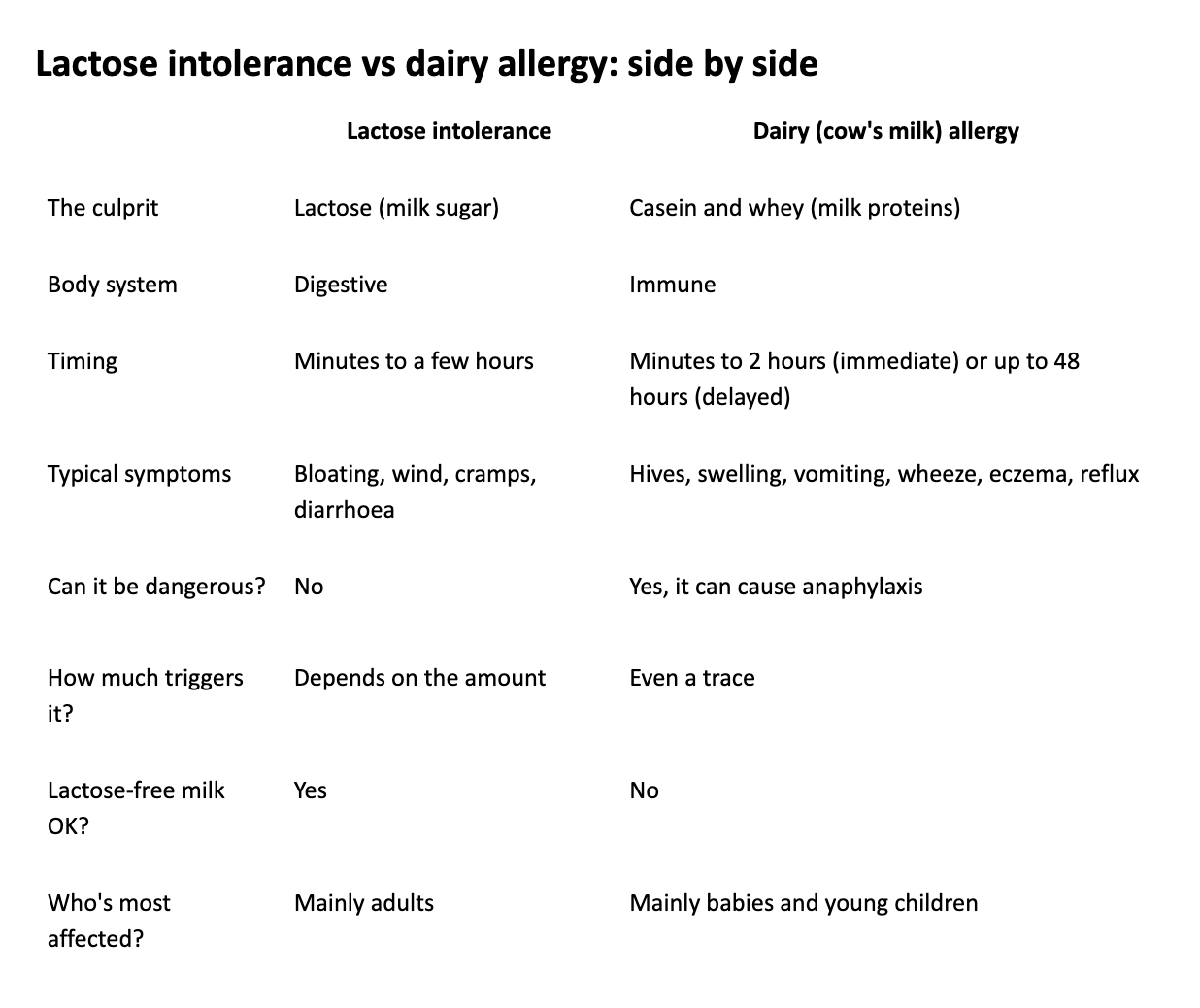
Lactose intolerance vs dairy allergy: side by side
Dairy myths that need to retire
How to find out which you have
Your questions, answered
The 30-second answer
Lactose intolerance is a digestion problem. Your body doesn't make enough lactase, the enzyme that breaks down lactose (milk sugar). Undigested lactose ferments in your gut, causing bloating, wind, cramps and diarrhoea. Uncomfortable, but not dangerous, and small amounts are often fine.
A dairy (cow's milk) allergy is an immune reaction to milk proteins, casein and whey. It can cause hives, swelling, vomiting or wheezing, sometimes within minutes, and occasionally anaphylaxis. Even a trace can trigger it, so strict avoidance is needed.
Quick rule of thumb: sugar problem = intolerance. Protein problem = allergy.
And then there's option three: a dairy intolerance to milk proteins, without a true allergy. It's the one most people have never heard of, and often the missing piece. More on that below.
Symptoms give you clues, not a diagnosis, and timing alone can't always tell the two apart. (For the bigger picture on how allergies and intolerances differ, see Food Intolerance vs Food Allergy.)
Lactose intolerance: when your gut can't do the maths
Lactose is the natural sugar in milk. To absorb it, your small intestine needs an enzyme called lactase to split it in two. Not enough lactase? The lactose travels on to your large intestine, where your gut bacteria throw a fermentation party. The by-products? Gas, bloating and a lot of noise.
According to the NHS, symptoms can start anywhere from a few minutes to a few hours after dairy:
Bloating and tummy pain
Wind and gut rumbling
Diarrhoea (or sometimes constipation)
Nausea
For some, headaches, tiredness or achy joints
Why does it happen? For most adults, lactase production simply drops after childhood. That's completely normal and very common worldwide. It can also follow a gut infection, coeliac disease, inflammatory bowel disease or gut surgery, and sometimes improves once the gut heals.
The good news: it's dose-dependent. Many people with lactose intolerance can handle a splash of milk in tea, hard cheese or live yoghurt without any drama. It's the pint-sized latte or creamy pasta sauce that tips you over.
Dairy allergy: when your immune system overreacts
A cow's milk allergy has nothing to do with lactose. It's your immune system mistaking milk proteins (casein and whey) for a threat. There are two types.
Immediate (IgE-mediated) milk allergy. Symptoms usually start within minutes and up to two hours: hives, itching, swelling of the lips or face, vomiting, coughing or wheezing. Rarely, it causes anaphylaxis. If you notice throat swelling, difficulty breathing or feeling faint, use an adrenaline auto-injector if you have one and call 999 (NHS).
Delayed (non-IgE) milk allergy. Mostly seen in babies and young children, symptoms can appear up to 48 hours later: reflux, eczema, diarrhoea, constipation, colic-type discomfort, or blood or mucus in nappies. Because it's slower and gut-based, it's easily mistaken for lactose intolerance.
One golden rule: if you suspect an allergy, please don't test it yourself with lactose-free milk or 'just a little bit' of dairy. Get it properly assessed first.
Is it just a baby thing? Mostly, yes. Allergy UK says around 2% of babies have a diagnosed cow's milk allergy, and most outgrow it by age five. Adult-onset milk allergy is very rare, but when a childhood allergy persists into adulthood, reactions can be more severe (Allergy UK). So new, fast reactions always deserve a GP visit. Parents, see Food Intolerance in Children for more.
The one nobody talks about: dairy intolerance
Here's a scenario I see all the time. You switch to lactose-free milk and feel no better. Allergy tests come back clear. Yet dairy still leaves you bloated, bunged up, breaking out or dragging yourself through the afternoon.
That's often a dairy intolerance, sometimes called milk protein sensitivity. It's a reaction to milk proteins like casein and whey rather than to lactose, and it's not an allergy, so it isn't life-threatening. But it can be properly miserable.
Common signs:
Bloating, wind or IBS-type symptoms that lactose-free products don't fix
Catarrh, a blocked nose or always needing to clear your throat
Skin flare-ups like eczema or breakouts
Headaches, fatigue or brain fog
Symptoms that turn up hours, or even a day or two, later
A big clue: you react to hard cheese or butter too. These are very low in lactose, so if they still cause trouble, the protein may be the issue rather than the sugar.
Little ones are different. In babies and young children, 'milk protein intolerance' is sometimes used to describe a delayed (non-IgE) milk allergy. That needs proper assessment with your GP or health visitor, not a home trial.
This is where IgG testing earns its place
An allergy (IgE) test won't pick up these slower reactions, and a breath test only looks at lactose. An IgG food intolerance test looks at your immune system's IgG response to dairy, alongside 200+ other foods and drinks.
That gives you a clear, personalised starting point: is dairy protein worth focusing on? Are other foods involved too? We then confirm the answer with a short, structured elimination and a careful reintroduction, so you only change what you need to. IgG results are a starting point rather than a diagnosis, and some allergy bodies, including BSACI and EAACI, caution against relying on them alone. That's why the elimination and reintroduction step matters.
Explore our food intolerance tests, or read our IgG vs IgE testing guide to see how they compare.
Dairy myths that need to retire
'Lactose-free means dairy-free.' Nope. Lactose-free milk is real cow's milk with the lactose pre-digested. Brilliant for intolerance, but it still contains milk protein, so it's not safe with a milk allergy.
'Goat's or sheep's milk is fine instead.' Their proteins are very similar to cow's milk, so most people with a milk allergy react to them too. They also contain lactose.
'A2 milk fixes everything.' A2 milk contains a different type of beta-casein, and some people find it easier on the gut. But it's still cow's milk protein and still contains lactose, so it isn't suitable for a milk allergy or true lactose intolerance.
'I have to give up cheese forever.' If it's intolerance, probably not! Hard, aged cheeses like Cheddar and Parmesan are naturally very low in lactose, and live yoghurt is often well tolerated thanks to its bacteria. (With a milk allergy, though, all of these are off the table.)
'Cutting out dairy is harmless.' Dairy is a major source of calcium, iodine, protein and vitamin B12 in the UK diet, and the NHS advises speaking to a GP or dietitian before cutting it out. If you do, choose unsweetened alternatives fortified with calcium (and ideally iodine and vitamin D), and remember an oat drink, a soya drink and a coconut yoghurt aren't nutritionally interchangeable.
Little ones need extra care: the NHS advises that babies under one shouldn't be given rice, oat or almond drinks, so always get professional advice before changing a child's diet.
How to find out which you have
Fast reaction? See your GP first. Hives, swelling, vomiting or wheezing soon after dairy points to allergy. Your GP or an allergy clinic can arrange skin prick or specific IgE blood tests, read alongside your history.
Gut symptoms? Consider a lactose test. A hydrogen breath test measures the gases produced when lactose isn't absorbed. Your GP may also suggest simply cutting lactose for a short while to see if symptoms ease. Blood in your poo, unexplained weight loss or ongoing bowel changes always need a GP check first.
Try a structured trial. Remove lactose for 2 to 4 weeks, then reintroduce it gradually to find your threshold. Most people can tolerate more than they think.
Not clear-cut? If you're reacting to more than just dairy, or symptoms persist on a lactose-free diet, something else may be going on, from FODMAPs to histamine to an unhappy gut. Our IgG vs IgE testing guide explains which tests help with which questions.
Putting the pieces together. Each test answers a different part of the dairy puzzle. A breath test or lactose-free trial tells you about the sugar. An IgE test tells you about allergy. An IgG test shows how your body responds to dairy proteins, which neither of the others picks up. Used together with a structured reintroduction, they help you work out whether it's the sugar, the protein or both, and what you can happily keep on your plate.
Whatever you do, don't diagnose yourself with an allergy and avoid dairy for years without a plan. That's a lot of missed calcium for a maybe.

Frequently Asked Questions
Can you develop lactose intolerance as an adult? Yes, it's very common. Lactase levels naturally fall with age for many people, and a gut infection or other gut condition can also trigger it.
Can a test tell me if I have a dairy intolerance? An IgG food intolerance test can show your IgG response to milk and other dairy proteins, giving you a personalised starting point. A short elimination and careful reintroduction then confirms what your body is happy with.
What if lactose-free milk still makes me bloated? That doesn't automatically mean a milk allergy. The coffee, other ingredients, the rest of the meal or another gut issue could be to blame. Note the product, portion and symptoms, and get advice if it keeps happening.
Is butter OK if I'm lactose intolerant? Usually, yes. Butter contains only tiny amounts of lactose, so most people with lactose intolerance are fine with it. It still contains milk protein, though, so it's off the menu with a milk allergy.
Do lactase enzyme supplements work? They can help some people with lactose intolerance enjoy dairy more comfortably, taken with the first mouthful (follow the product instructions). They do nothing for a milk allergy.
References:
NHS. Lactose intolerance.
NHS. Food allergy.
Allergy UK. Your baby's cow's milk allergy journey.
Allergy UK. Cow's milk allergy in adults.
This article is for general information and doesn't replace medical advice. Seek medical advice for persistent symptoms, unexplained weight loss or blood in your stools. If you suspect a milk allergy, speak to your GP. In an emergency, call 999.
Don’t forget to pin it.
Done playing dairy roulette?
You don't need to arrive knowing which test to buy or which foods to cut. We'll start with your symptoms, help you choose the right test, then go through your results with you in context. If a dietary trial makes sense, we'll plan balanced swaps, track how you respond and guide your reintroduction, so you only change what you need to. Already have results from elsewhere? Bring them along.
Take the free Find Your FIT Quiz to discover which test or programme suits your symptoms, or book a free 15-minute Personalised FIT Health Review with Becki for a direct, no-obligation conversation about where to start.

About Becki Hawkins
Becki Hawkins, BSc (Hons), mBANT, CNHC, is the founder of FIT Nutrition & Testing Clinic and a Registered Nutritional Therapist with over 20 years of experience. She specialises in evidence-based personalised nutrition and functional testing, helping clients uncover the root causes of digestive issues, hormonal imbalances, and unexplained symptoms. Becki combines clinical expertise with culinary creativity, translating complex test results into practical, delicious nutrition plans that work in real life. Her approach is simple: test, don't guess. Because guessing doesn't heal. Knowing does.