

You've swapped your milk, stopped buying bread and spent far too long trying to work out what upset your stomach. But are you dealing with a food intolerance, a food allergy or something else altogether?
The terms are often used interchangeably. Understanding the difference helps you choose the right investigation and get support that actually fits your situation.
At FIT Nutrition & Testing Clinic, I help clients make sense of food-related symptoms, understand their testing options and put practical nutrition advice into everyday life. This guide explains where allergy and intolerance differ, where they overlap and how to take the next step.
Contents
Food intolerance vs food allergy at a glance
What is a food allergy?
What is a food intolerance?
Milk allergy vs lactose intolerance
Is a reaction to wheat an allergy or intolerance?
Food allergy and food intolerance testing explained
What to do if you suspect a food reaction
Your questions, answered
Food intolerance vs food allergy at a glance
A food allergy involves the immune system reacting to a food, usually a protein. Some reactions happen quickly and can be life-threatening; others are delayed.
Food intolerance describes difficulty tolerating a food or ingredient without an allergic reaction. It often causes digestive symptoms and may depend on the amount eaten.
Timing and symptoms provide clues, but cannot confirm the cause on their own (NHS, NHS).
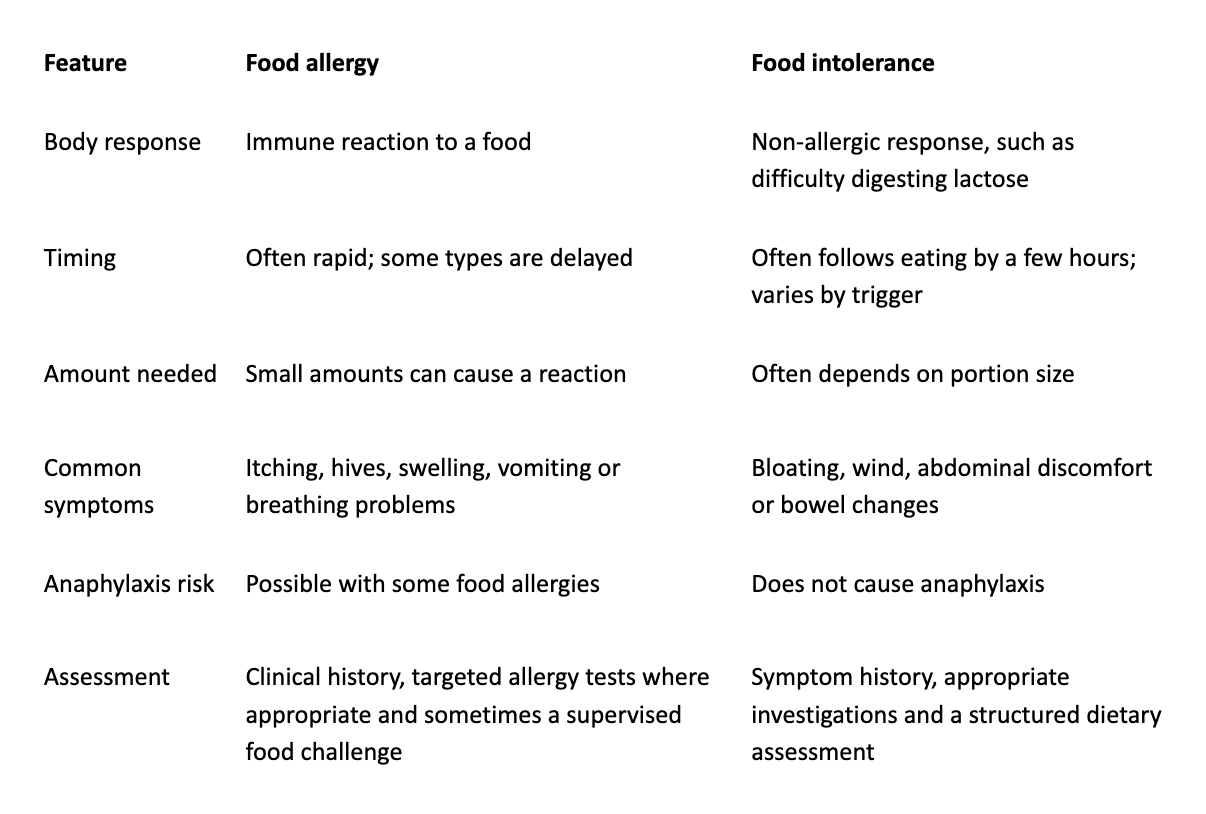
What is a food allergy?
A food allergy happens when the immune system treats a food as a threat. Milk, eggs, peanuts, tree nuts, wheat and shellfish are familiar examples, although many other foods can cause allergic reactions (NHS).
In an IgE-mediated food allergy, antibodies called immunoglobulin E are involved. Reactions are usually rapid and can affect several parts of the body. Food allergy symptoms may include an itchy mouth, hives, swelling, vomiting, abdominal pain or wheezing.
Non-IgE-mediated food allergies involve other immune pathways. Symptoms can develop later, making the connection less obvious. This is particularly relevant when investigating cow's milk allergy in babies and young children. A delayed reaction should not automatically be labelled an intolerance (NHS, Allergy UK, NHS). Parents can read more in Food Intolerance in Children.
The amount that triggers a reaction varies. Someone with a confirmed allergy needs individual advice about avoidance, cross-contact and an allergy action plan.
When a food reaction needs emergency help
Sudden throat or tongue swelling, difficulty breathing or swallowing, collapse or marked faintness can signal anaphylaxis. Use prescribed emergency adrenaline immediately and call 999, saying you suspect anaphylaxis. Call 999 even if you seem to be feeling better after using it, and do not wait for a rash or for symptoms to settle. Follow the emergency instructions and your allergy action plan (NHS, NHS).
For suspected food allergy without emergency symptoms, arrange a GP assessment. FIT can support the nutritional side of food avoidance alongside appropriate medical care.
What is a food intolerance?
Food intolerance is a non-allergic adverse response to a food or ingredient. It can be disruptive even though it does not cause anaphylaxis. Bloating after eating, excess wind, abdominal discomfort and changes in bowel habit are common reasons people seek help (NHS).
Unlike many allergic reactions, intolerance symptoms often depend on quantity. You might tolerate a small serving but feel uncomfortable after a larger one. What else you eat, meal size and existing digestive conditions may also influence how you feel.
Symptoms alone do not identify the food responsible. IBS, coeliac disease and other conditions can cause similar problems, so recurring symptoms deserve assessment rather than an ever-growing list of foods to avoid.
Common food intolerance triggers
Lactose is the sugar in milk. If you do not produce enough of the enzyme lactase, lactose can reach the large bowel without being fully digested, leading to digestive symptoms. Some people tolerate modest amounts or particular dairy products better than others (NHS).
FODMAPs are fermentable carbohydrates found in foods including onions, garlic, wheat and some beans and fruits. They can contribute to symptoms in people with IBS. A low-FODMAP approach is a structured dietary trial rather than a permanent instruction to avoid these foods, and NICE says this kind of exclusion diet should only be given by a healthcare professional with expertise in dietary management (NICE).
Other possible triggers include caffeine, alcohol, histamine, sulphites and other food chemicals (NHS). Histamine-related symptoms can be more complex to assess, and there is no routinely recommended diagnostic test for histamine sensitivity (BSACI). For more, read Histamine Intolerance or MCAS?
Milk allergy vs lactose intolerance
This distinction matters when choosing dairy alternatives.
Cow's milk allergy involves an immune reaction to milk proteins. Lactose intolerance involves difficulty digesting milk sugar. Lactose-free cow's milk still contains milk proteins, so it is not a suitable substitute for someone with cow's milk allergy (NHS, BSACI).
If you need to avoid dairy, the replacement matters too. Calcium, iodine, protein and vitamin D content can vary considerably between alternatives. Nutritional support can help you make swaps that suit your needs rather than simply removing a food group.
Is a reaction to wheat an allergy or intolerance?
Feeling unwell after bread or pasta does not automatically mean gluten is the problem. Three different possibilities are worth understanding:
Wheat allergy is an allergic response to proteins in wheat.
Coeliac disease is an autoimmune condition in which gluten damages the small intestine. It is neither a food allergy nor a food intolerance.
Non-coeliac gluten or wheat sensitivity describes symptoms similar to coeliac disease when no antibodies are produced and there is no damage to the gut lining. There is no specific diagnostic test, and it is debated whether gluten itself is responsible: FODMAPs and other non-gluten wheat proteins are removed from the diet at the same time (Coeliac UK).
Speak to your GP about coeliac testing before removing gluten. Starting a gluten-free diet can affect the accuracy of the investigation (NHS).
For a closer look, read our guide to Gluten Intolerance vs Coeliac Disease.
Food allergy and food intolerance testing explained
The most useful investigation depends on your symptoms and the question you need answered. A test for milk allergy, for example, does not assess whether you digest lactose properly.
Food allergy tests
Skin-prick tests and food-specific IgE blood tests can support the assessment of suspected immediate allergy. Results need to be interpreted alongside your reaction history: a positive result does not automatically mean that eating the food causes symptoms. Some people need a medically supervised oral food challenge to clarify the picture (NHS, BSACI).
Tests for digestive symptoms
Breath testing may be appropriate when lactose malabsorption is suspected. Coeliac blood tests investigate a separate autoimmune condition. For many other food-related symptoms, a detailed history, food and symptom diary, and carefully planned exclusion and reintroduction provide more useful information than a broad test panel. BSACI notes there is currently no reliable validated test for confirming food intolerance, with the exceptions of lactose intolerance and coeliac disease (NHS, NHS, NHS, BSACI).
Food-specific IgG testing at FIT
FIT offers food-specific IgG testing with practitioner support. These blood tests measure IgG antibodies to a panel of foods. They do not diagnose food allergy, lactose intolerance or coeliac disease, and an elevated IgG result does not establish that a food is causing symptoms. IgG antibodies can reflect normal exposure to foods, and professional allergy bodies do not recommend this testing to diagnose food intolerance (BSACI, ASA/CAP).
If you are considering an IgG panel, I can explain what it measures, its limitations and the support available, so you can make an informed choice. Any proposed dietary changes need to be considered alongside your symptoms, medical history and nutritional needs. Results should not become a permanent list of foods you cannot eat.
At FIT, the conversation starts with you: what happens after eating, what has already been investigated and what you want help with. We can then discuss whether any of our testing services are relevant and how nutritional support could fit around them.
Explore FIT's food testing services to compare the options and the practitioner support available. For a closer look at the two antibody tests, read IgG vs IgE Testing: Which Test Do You Actually Need?
What to do if you suspect a food reaction
Start with a useful symptom history
Record what you eat and drink, approximate portions, when symptoms begin and how long they last. Include medicines, bowel habits, stress and sleep. These details help distinguish a repeatable food pattern from symptoms that happen for several different reasons.
Check what needs medical investigation
See your GP if symptoms keep coming back, or if you think you or your child may have a food allergy (NHS, NHS). Do not cut foods out of your own or your child's diet without speaking to a GP or dietitian first (NHS, Allergy UK). Do not remove gluten before discussing coeliac testing (NHS).
Make dietary changes with a clear plan
When an exclusion trial is appropriate, agree which food is being changed, for how long and what will replace it nutritionally. BSACI advises that exclusion diets are guided by a dietitian and kept to a set period, not exceeding 6 to 8 weeks. Changing several things at once makes it harder to know what helped.
Reintroduction is part of the assessment, not an optional extra. It can help establish whether symptoms recur and what amount you tolerate. Reintroduction can often be done at home, but where IgE-mediated allergy is suspected or reactions have been severe, BSACI says it should be done in hospital as a supervised challenge, so do not try a food challenge at home in that situation (BSACI).
The aim is a manageable, varied diet. You should leave with more understanding of your food choices, rather than more anxiety about them.

Your questions, answered
Can any food cause an allergy? Yes. Allergy UK says any food can cause an allergic reaction, not only the 14 regulated allergens that must be declared on labels: celery, cereals containing gluten, crustaceans, eggs, fish, lupin, milk, molluscs, mustard, peanuts, sesame, soya, sulphur dioxide and sulphites, and tree nuts (Allergy UK). If you think you may have a food allergy, see your GP (NHS).
Can food intolerance cause symptoms outside the gut? The NHS lists headache, tiredness, joint pain and rashes among the possible symptoms (NHS), but these are not specific to food intolerance. Do not assume that fatigue, skin changes or other persistent symptoms mean you need to remove a food.
Can you have both a food allergy and an intolerance? Yes. They are different processes and can coexist. Each needs its own assessment; one test cannot explain every possible reaction to food.
Do food intolerances last forever? Not necessarily. Tolerance depends on the cause and can change. Some people can include smaller portions, while others need ongoing adjustments. Review exclusions periodically with appropriate support rather than assuming they must be lifelong (NHS).
References
NHS. Food allergy.
NHS. Food intolerance.
NHS. Anaphylaxis.
NHS. Lactose intolerance.
BSACI. Guideline for the diagnosis and management of cow's milk allergy.
Coeliac UK. Gluten sensitivity.
BSACI. Diagnostic diets.
Allergy UK. Food allergy.
This article provides general information and does not replace individual medical advice. If you suspect a serious allergic reaction, call 999.
Don’t forget to pin it.
Get personalised food testing and nutrition support at FIT
If your food choices are becoming more restricted and you still do not feel clear about your symptoms, I can help you work through the next steps.
At FIT Nutrition & Testing Clinic, we discuss your history and testing options, explain results in context and help translate appropriate dietary advice into meals you can enjoy. Where medical investigation is needed, that forms part of the plan too.

About Becki Hawkins
Becki Hawkins, BSc (Hons), mBANT, CNHC, is the founder of FIT Nutrition & Testing Clinic and a Registered Nutritional Therapist with over 20 years of experience. She specialises in evidence-based personalised nutrition and functional testing, helping clients uncover the root causes of digestive issues, hormonal imbalances, and unexplained symptoms. Becki combines clinical expertise with culinary creativity, translating complex test results into practical, delicious nutrition plans that work in real life. Her approach is simple: test, don't guess. Because guessing doesn't heal. Knowing does.