
Low Testosterone in Men: Symptoms, Causes and When to Get Tested

Tired, flat, and not really 'in the mood' anymore? Before you blame your testosterone (or buy a booster from a man with a suspiciously good jawline), read this.
Your energy's gone AWOL. Your sex drive seems to have followed it. The gym sessions that used to leave you buzzing now feel like another item on the to-do list. And somewhere around 11pm, Google confidently tells you the answer: low testosterone.
Maybe. Low testosterone is a real, treatable medical condition. But so are several other things that look remarkably similar, from poor sleep to thyroid problems to plain old burnout.
The good news? You don't have to guess. With the right symptoms, the right test, at the right time of day, you can get a proper answer. Here's how.
Not sure where to start? The Find Your FIT quiz gives you a personalised wellness profile in a few minutes.
Contents
The short answer
What does testosterone actually do?
Low testosterone symptoms to look out for
The great pretenders: what else could it be?
What causes low testosterone?
Is it just getting older?
How to test testosterone properly
Where Well Man 360 fits
What you can do right now
Your questions, answered
The short answer
Low testosterone (male hypogonadism) is diagnosed using symptoms plus consistently low testosterone in morning blood tests. One low result isn't enough: it needs repeating on a different morning. The most telling clues are low libido, fewer morning erections and erection problems. Tiredness, low mood and losing strength matter too, but they have plenty of other possible causes.
What does testosterone actually do?
Testosterone helps run sex drive and erections, sperm production, muscle and bone strength, and red blood cell production. It's made mainly in the testes, following signals from the brain's hormone control centre (the pituitary). A problem at either end can lower it.
What it isn't, despite the internet, is a score for masculinity, motivation or how much you can deadlift. And higher isn't automatically better.
Low testosterone symptoms to look out for
Lower sex drive
Fewer morning or spontaneous erections
Erection problems
Losing muscle or strength
Low energy or low mood
Less body hair, or shaving less often
Fertility problems
Weaker bones or unexpected fractures, in some cases
It's the pattern that matters, not how many boxes you tick. Sexual symptoms tend to be more telling than tiredness on its own.
And if talking about your erections with your GP makes you want to hide under the desk: they've heard it all before, many times. It's just another symptom to them.
The great pretenders: what else could it be?
This is where most men get stuck, and where a proper look at the bigger picture earns its keep.
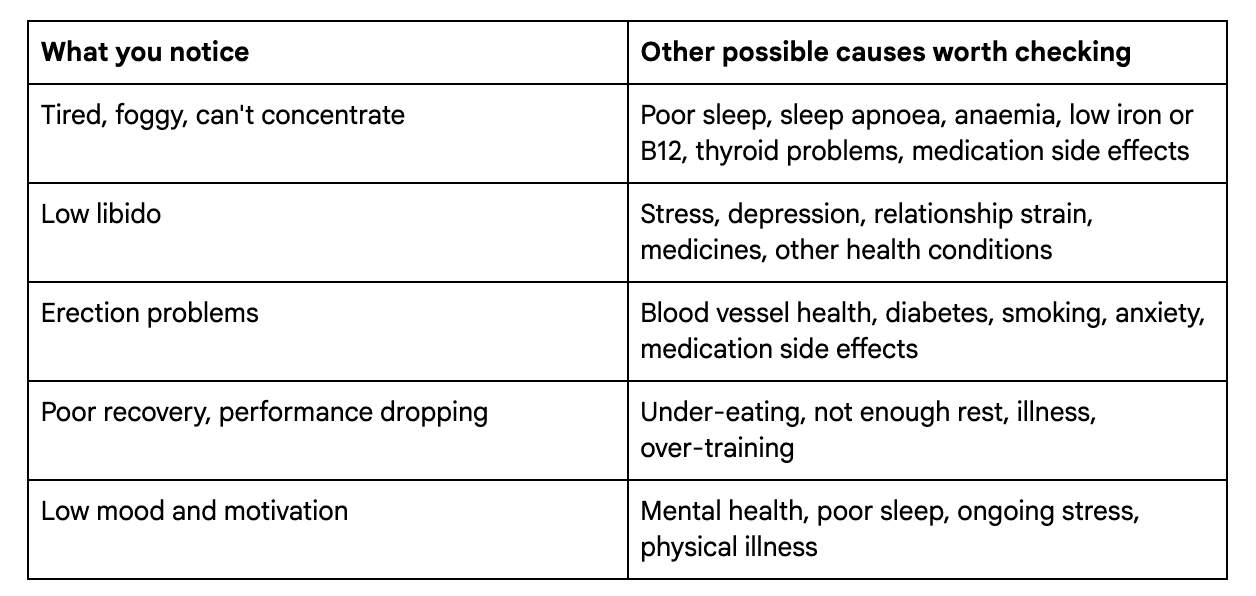
Several of these can happen alongside low testosterone, so finding one doesn't rule out the other. 'It's probably your lifestyle' should start a conversation, not end it.
What causes low testosterone?
Doctors look at two main routes: the testes not producing enough (from injury, disease, some genetic conditions or certain treatments), or the brain's hormone signals not getting through (such as pituitary problems).
Testosterone can also fall with obesity, type 2 diabetes, significant illness, some medicines, and anabolic steroid use. Some of these are reversible, which is exactly why finding the cause matters before anyone talks about treatment.
Tell your clinician about everything you take, including gym products, supplements and any past steroid use. No judgement, it just helps them read your results properly. (Don't stop any prescribed medicine without advice.)
Is it just getting older?
Testosterone does drift down gradually, by about 1% a year from your 30s or 40s, according to the NHS. But the NHS calls 'male menopause' an unhelpful term: men don't get the sudden hormone drop that women do. That slow decline usually isn't the problem on its own, so persistent symptoms shouldn't be shrugged off as an unwanted birthday present.
How to test testosterone properly (and avoid a misleading result)
Here's the plot twist most men don't know: when you test matters almost as much as whether you test.
Test in the morning, ideally fasted. Testosterone peaks in the morning and dips later in the day, so an afternoon test can make normal levels look low. UK guidance from the Society for Endocrinology and ACB recommends morning samples. Work nights? Mention it, as your timing may need adjusting.
Don't test when you're ill. A bad cold, a big night or a brutal week can all temporarily knock your levels.
Repeat a low result. A single low reading needs confirming on a different morning before anyone calls it low testosterone.
Look at the whole picture. Total testosterone alone doesn't always tell the full story. SHBG (the protein that carries testosterone around your blood) and free testosterone can explain borderline or confusing results, and LH and FSH help show whether the issue is in the testes or the brain's signals.
If you suspect low testosterone, your GP is the right place to start: they can confirm a diagnosis, look for the cause and discuss treatment if you need it.
Want the bigger picture? Where Well Man 360 fits
Here's the thing: low energy, low libido and poor recovery rarely have just one cause. That's why I love a joined-up view.
Our Well Man 360 Complete Hormone & Biomarker Assessment checks 63 markers from a morning fasted blood sample, analysed by a UKAS-accredited lab. Alongside testosterone, free testosterone, SHBG, LH and FSH, it covers:
Thyroid: TSH, FT4, FT3 and thyroid antibodies
Energy and nutrients: iron, ferritin, vitamin D, B12, folate, magnesium and zinc
Metabolic and heart health: HbA1c and a full cholesterol profile
Liver, kidney and full blood count, plus PSA for prostate health
In other words, many of the 'great pretenders' in one go. Then comes the bit that makes the difference: a 1:1 consultation where I go through your results with you and build a personalised nutrition, lifestyle and supplement plan around them. Anything that needs medical follow-up, we'll flag for your GP.
Well Man 360 is a broader health assessment. It complements, rather than replaces, the repeat testing and clinical assessment your GP uses to diagnose testosterone deficiency. Already have GP results? Bring them along.
'I'm training harder, recovering faster, and performing better in my sport and training.' Adam Palmer-Coole, after male hormone and metabolic health testing and diet changes based on his results
Individual experience; results vary.
What you can do right now
You don't have to wait for results to start getting the basics right.
Guard your sleep. Testosterone follows a daily rhythm, and poor sleep can affect it. If you snore heavily or wake up unrefreshed, ask your GP about sleep apnoea.
Eat enough for what you do. Chronic under-eating and over-training are classic culprits in active men.
Build meals around protein, fibre and healthy fats, and keep an eye on alcohol.
Aim for steady, sustainable changes, not crash diets.
Be wary of 'testosterone boosters'. They can't reliably fix an unexplained hormone problem. Correcting a confirmed deficiency (like low vitamin D or zinc) can make sense; mega-dosing on a hunch doesn't.
Frequently Asked Questions
Can low testosterone make you tired?
Yes, but tiredness isn't specific to low testosterone. Sleep problems, anaemia, thyroid issues and mental health can all play a part, which is why a broader check is so useful.
Can I have low testosterone in my 20s or 30s?
Yes. It's not just a midlife issue. Persistent symptoms deserve a look, whatever your age.
My first result was low. What now?
Don't panic. Speak to your GP about a repeat morning test, along with a review of your symptoms, health and medicines.
Does low testosterone always mean treatment?
No. It depends on the confirmed diagnosis, the cause and your circumstances. If fertility matters to you, say so early: prescribed testosterone can suppress sperm production.
Is testosterone important for women too?
Absolutely, although assessment and treatment are different. Read Low Testosterone in Women.
References:
NHS. The 'male menopause'.
Jayasena, C.N. et al. (2023). Society for Endocrinology and Association for Clinical Biochemistry and Laboratory Medicine position statement: standardising the biochemical confirmation of adult male hypogonadism. Annals of Clinical Biochemistry, 60(4), 223-227.
This article is for general information and doesn't replace medical advice. Persistent symptoms and suspected testosterone deficiency need medical assessment.
Don’t forget to pin it.
Ready to get some real answers?
If your energy, libido or recovery has changed, you deserve more than a guess and a tub of powder.
Explore Well Man 360 for a complete picture of your hormones and wider health, with personalised nutrition support.
Book a free 15-minute Personalised FIT Health Review with Becki for a direct, no-obligation conversation about where to start.

About Becki Hawkins
Becki Hawkins, BSc (Hons), mBANT, CNHC, is the founder of FIT Nutrition & Testing Clinic and a Registered Nutritional Therapist with over 20 years of experience. She specialises in evidence-based personalised nutrition and functional testing, helping clients uncover the root causes of digestive issues, hormonal imbalances, and unexplained symptoms. Becki combines clinical expertise with culinary creativity, translating complex test results into practical, delicious nutrition plans that work in real life. Her approach is simple: test, don't guess. Because guessing doesn't heal. Knowing does.