
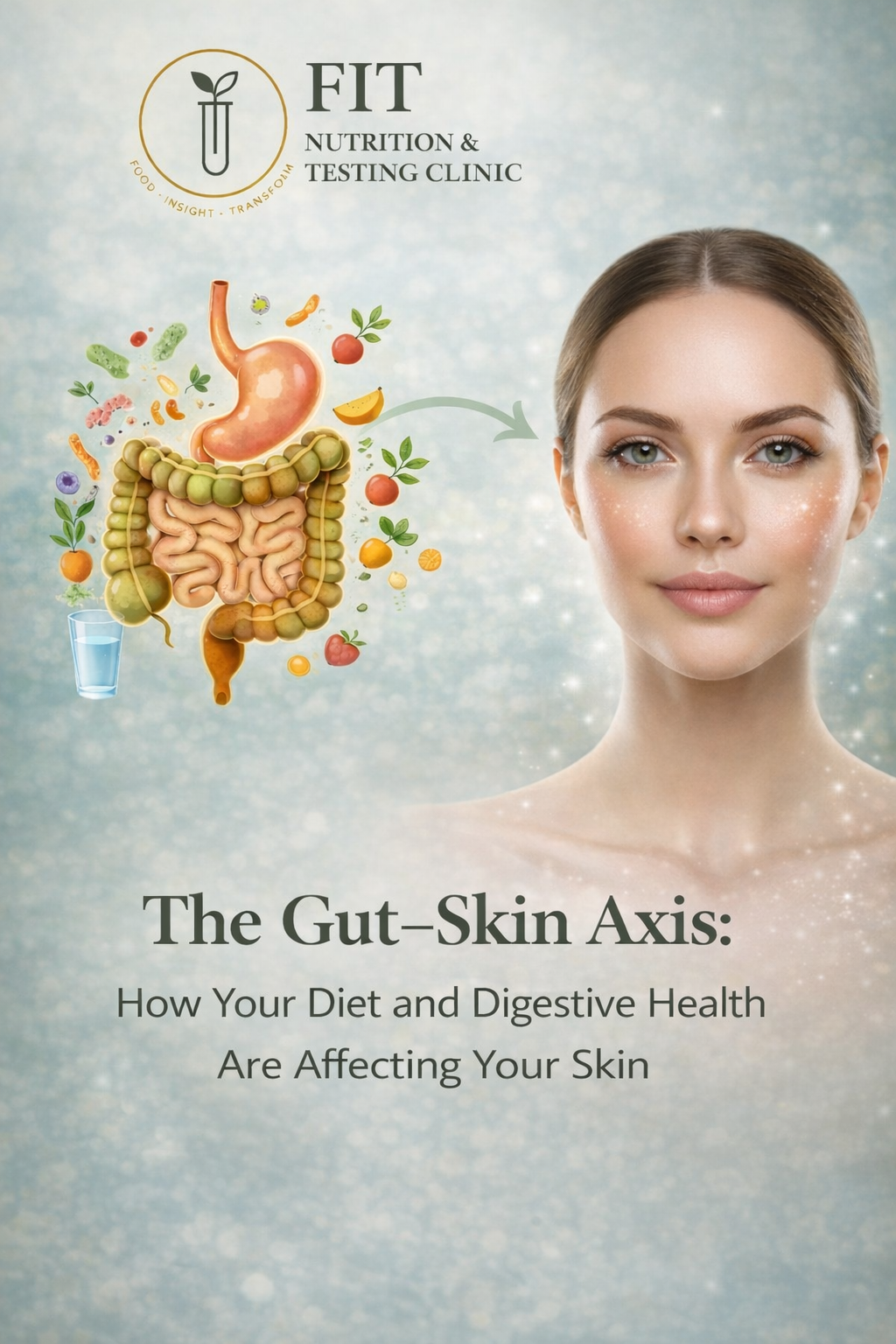
The Gut-Skin Axis: How your Diet and Digestive Health are Affecting your Skin

Why persistent eczema, acne and rosacea often trace back to the gut, not the skincare shelf
You've bought the 'miracle' cleanser. Switched to 'clean' skincare. Tried cutting sugar, dairy, gluten, and maybe your patience along with it.
And yet your skin still flares. Breakouts appear seemingly at random. Redness won't calm down. Eczema keeps coming back. Rosacea has a mind of its own.
If any of that's you, here's the thing worth hearing first: you're not doing anything wrong, you're just looking in the wrong place. For many clients, the real issue isn't on their face. It's in their gut.
Contents
Why your digestive system affects your skin
'But my digestion is fine'
What is 'leaky gut'
Skin conditions commonly linked to gut imbalance
Why guessing with diet rarely works
Rebuilding skin health from the inside
Stress, sleep and skin
Collagen and skin repair
FAQs
Why your digestive system affects your skin
Your gut and your skin are in constant communication, linked through the immune system, inflammatory pathways, hormones, gut bacteria and nutrient absorption. This is known as the gut-skin axis, and it's a genuinely active area of research: several recent reviews have found gut microbiota dysbiosis linked to inflammatory skin conditions including eczema (atopic dermatitis), acne, rosacea and psoriasis (Thye et al., 2022, Gut Microbes; systematic review, ScienceDirect, 2025).
When gut bacteria are balanced, skin tends to be calmer and more resilient. When the gut is inflamed, skin often becomes more reactive, spotty or sensitive. In clinic, this shows up even when digestion itself seems fine, gut issues don't always come with obvious tummy symptoms.
'But my digestion is fine'
One of the most common things clients say is: 'I don't have bloating or IBS, so surely it's not my gut?' It still can be. Skin symptoms are often one of the first visible signs of an internal imbalance, even before digestive symptoms become noticeable.
What is 'leaky gut'
'Leaky gut,' or increased intestinal permeability, describes a gut lining that's become more porous than it should be. Normally, the gut lining works like a filter, letting nutrients through while keeping toxins and undigested particles out. When that filter is compromised, undigested food particles, toxins and bacterial fragments can slip into the bloodstream, prompting an immune response and raising inflammation, which can then show up on the skin.
Skin conditions commonly linked to gut imbalance
Eczema. Immune overactivity linked to gut permeability can make skin more reactive, and is often worsened by food intolerances.
Acne. Not just a hormonal condition, gut bacterial imbalance can drive inflammation and excess oil production too.
Rosacea. One of the more strongly evidenced links here: a landmark study found small intestinal bacterial overgrowth (SIBO) in 46% of rosacea patients compared with 5% of matched controls, and treating the SIBO led to complete resolution of skin lesions in the majority of those cases (Parodi et al., 2008; confirmed by a 2025 meta-analysis showing a more than three-fold increased risk of SIBO in rosacea patients, summarised in PMC10800857).
Psoriasis. An autoimmune condition where inflammation is often connected to gut barrier issues.
If a skin condition is cyclical, stress-related, resistant to creams, or better one week and worse the next, it's worth looking deeper rather than treating the skin in isolation.
Why guessing with diet rarely works
Cutting dairy, then gluten, then sugar, then everything, and still flaring, is exhausting and often unnecessary. At FIT, practitioner-guided testing through the Advanced Food Intolerance Assessment helps identify specific triggers rather than relying on trial and error.
Worth being upfront here: IgG food intolerance testing is a genuinely debated area, some allergy bodies have raised concerns that IgG levels mainly reflect food exposure rather than true intolerance. In practice, results are used as one part of a wider personalised picture rather than a standalone diagnosis. When the right triggers (not all foods) are removed this way, clients often notice inflammation reducing, the gut lining repairing, and skin calming as a result.
If ongoing gut imbalance seems to be part of the picture, our Gut Microbiome Assessment looks at this directly.
Rebuilding skin health from the inside
Once inflammation has calmed, the focus shifts to nourishing and repairing:
L-glutamine. Commonly used to support gut lining repair. Zinc. Involved in wound healing and oil regulation. Omega-3s. A well-established anti-inflammatory nutrient. Probiotics, where appropriate. Support rebuilding microbial balance. Fibre and polyphenols. Feed the beneficial bacteria linked to skin resilience.
This is internal skincare, and for a lot of clients, it genuinely moves the needle where topical treatment alone hasn't.
Stress, sleep and skin
Food matters, but it isn't everything. Stress increases gut permeability, poor sleep limits repair, and constant overwork places extra load on the immune system. Alongside nutrition, it's worth paying attention to nervous system regulation, 7 to 9 hours of sleep, gentle movement, journaling or a 'mind dump,' and mindful eating. A calmer body supports a calmer gut, which supports calmer skin.
Collagen and skin repair
Collagen provides amino acids that support gut lining repair, immune balance and skin elasticity, the elasticity benefit in particular has reasonable evidence behind it from clinical trials on oral collagen supplementation. Some clients choose supplements such as Ancient & Brave alongside dietary improvements for added support. Enjoy 20% off your first single purchase using code 'BECKINUTRITIONIST' at checkout. Supplements never replace food, but they can support recovery alongside it.
Frequently Asked Questions
Can gut problems really cause acne? Yes, gut inflammation and dysbiosis can increase systemic inflammation and affect hormone balance, both of which play a role in acne.
Can food intolerance cause eczema? It can contribute. Immune reactions to specific foods may worsen skin sensitivity and flare-ups in people who are prone to eczema.
How long does it take to see a difference in skin through gut healing? Most clients notice changes within 6 to 12 weeks on a personalised programme, though this varies depending on what's driving the skin condition.
Do I need to cut lots of foods forever? No. The approach is to remove, repair, then reintroduce strategically, rather than restrict indefinitely.
Is testing better than elimination diets? Testing helps target the right foods rather than removing everything at once, which tends to prevent unnecessary restriction and gets to useful answers faster.
Sources:
Thye, A.Y. et al. (2022). Gut-Skin Axis: Unravelling the Connection between the Gut Microbiome and Psoriasis. PMC9138548
Rosacea, microbiome and probiotics: the gut-skin axis. PMC10800857
Relationship between skin and gut microbiota dysbiosis and inflammatory skin diseases in adult patients: a systematic review. ScienceDirect
Don’t forget to pin it
Ready to Heal Your Gut & Glow From Within?
If you’re struggling with eczema, acne, rosacea or chronic sensitivity — and nothing seems to work — it may be time to stop treating symptoms and start addressing the cause.
Take the quiz or book your FREE health review.

About Becki Hawkins
Becki Hawkins, BSc (Hons), mBANT, CNHC, is the founder of FIT Nutrition & Testing Clinic and a Registered Nutritional Therapist with over 20 years of experience. She specialises in evidence-based personalised nutrition and functional testing, helping clients uncover the root causes of digestive issues, hormonal imbalances, and unexplained symptoms. Becki combines clinical expertise with culinary creativity, translating complex test results into practical, delicious nutrition plans that work in real life. Her approach is simple: test, don't guess. Because guessing doesn't heal. Knowing does.